
Country: United States of America (the)
About me
My romance with watercolor started when I studied architecture in college at the Azerbaijan Engineering and Construction University in Baku (1977–1982). Among other subjects, watercolor painting was a prerequisite for architectural rendering. Other interesting disciplines were the rules of perspective drawing and classical theory of shadow composition. Nowadays this all can be done with a few clicks on computer! But in college, we learned it the same way as it was taught for centuries—and the text books we used were even older than our professors.
For a time, life forced me to set painting aside. But later when I finally had more free time on my hands, I started painting again. First, traditional watercolor with underpainting, proper perspective; one that looks like old architectural rendering—dry and boring.
Later I realized that I need to develop my own visual language, one that will help me to express myself, my thoughts, and my emotions; language that will be more attractive and better understood by viewers. That it is more interesting to paint light and darkness, depict the mood of a scene, or create order from chaos. However, it took me a while to get there—and this process is far from finished. I also tried different mediums (though watercolor is my favorite), along with different tools and a less realistic approach.
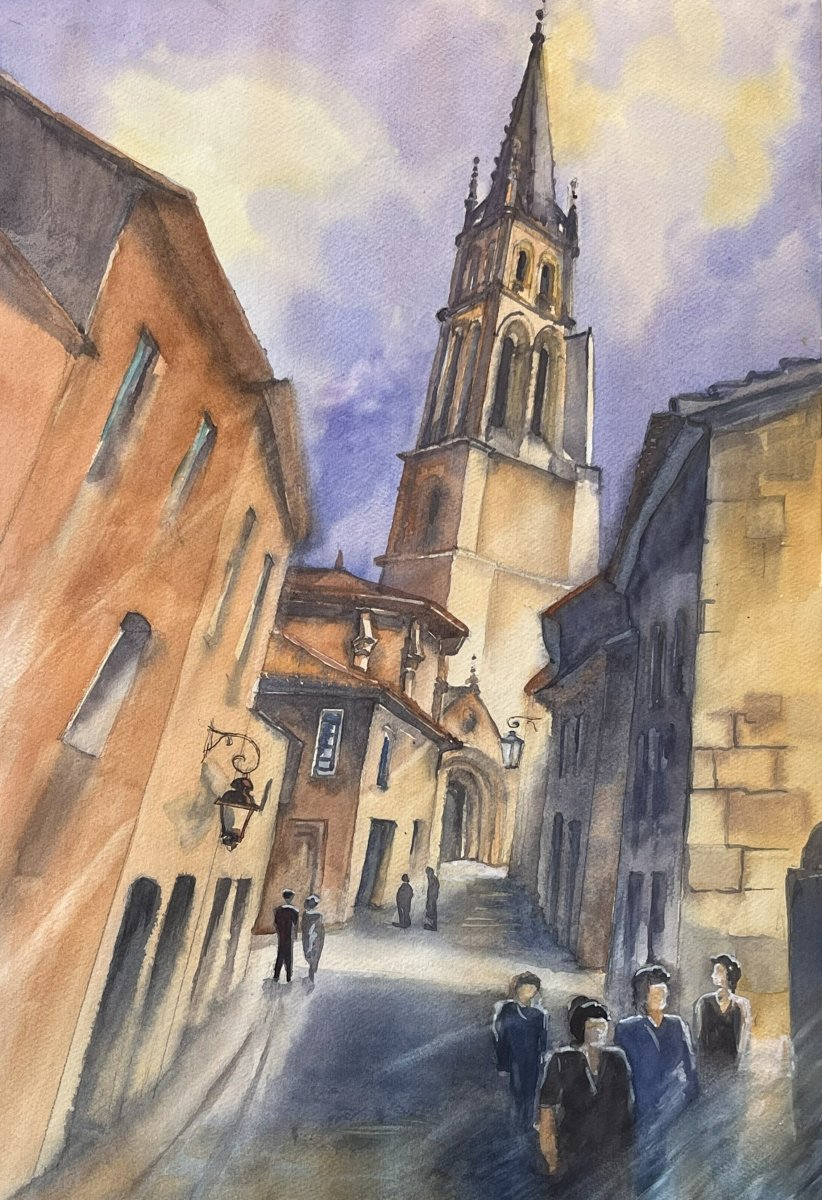
I love to travel and to see new places, cities, and counties. That is part of why historical architecture is my passion. With great enthusiasm, I frequently visit little forgotten villages, climb up walls of medieval citadels, and scrutinize paintings or mosaics on cathedral ceilings until my neck hurts. Then I paint what I see. And the more I am in love with a particular country, the more I paint.
I have been a member of WAS-H (Watercolor Art Society of Houston) and Society of Watercolor Artists, Dallas for many years and enjoyed plenty of workshops